- Interview Date: 10/10/2025
- Interview Location: Anime NYC 2025
- Interview Format: In-Person, One-on-One
Anime Herald: At its core, Dragon Head is a story about fear and terror. Where did you get the inspiration for it?
Minetarō Mochizuki: In my adolescent years, I read a lot of horror novels, including Russian and Japanese. A lot of the novels tackled the theme of darkness and the fear of darkness. When I was growing up I felt like I wanted to write something similar.
There’s also a Japanese manga artist, (Kazuo) Umezu-sensei, who wrote a lot of horror manga as well. I drew a lot of inspiration from his works.

Unknown Outlet: Your early works were stories about youth. Later, you switched to horror. Why did you make that switch?
Minetarō Mochizuki: When I first made my debut as a manga artist, I didn’t think I could tackle topics like abstract horror. I decided to write about things that were tangible to myself. As I grew as a manga artist, I felt more understanding of these themes and was able to delve into those pieces.
Manga Mavericks: What was it like working on the manga adaptation of Wes Anderson’s Isle of Dogs?
I was ecstatic when I got the offer, as I am a huge fan of Wes Anderson’s works. It’s a stop-motion animation, which made it very difficult for me to turn it into a manga. Although I was very happy to receive the offer, it was a challenging project.
Anime Doctor: Dragon Head is unrelentingly claustrophobic and surreal. How did you maintain the tension without exhausting or desensitizing your readers?
Minetarō Mochizuki: When I was writing Dragon Head, I made sure to maintain the perspective of the characters. There were no overhead shots to convey what the outside world was like. I made sure to maintain the perspective of the characters. I wanted the readers to sympathize and feel the same emotions as the characters.
Not showing things was just as important. Don’t reveal too much. Don’t make things too clear. Leave readers with no choice but to imagine. “Fear is born from imagination.”
—that’s what I believed.

Anime Herald: What advice do you have for authors and artists who might not have much confidence in themselves?
Minetarō Mochizuki: I feel the same way, so I completely understand that struggle. In the film Field of Dreams, there’s a scene where the protagonist simply carves out a cornfield and keeps building a baseball field. I think creators are the same. If you make something, something will happen. That’s why, when you’re unsure, you should just take the first step.
Unknown outlet: A few years ago, Mochizuki-sensei gave an interview where he said Dragon Head was partly inspired by the 1995 Kobe earthquake and the collapse of Japan’s economy. I was wondering what his current thoughts are on the state of Japan and what events are currently influencing his work?
Minetarō Mochizuki: One clarification. In the interview, a more accurate answer is that when Japan collapsed financially, it affected me personally. I felt like there were spirits around me When I write manga, It just comes out from the feelings that I feel. In terms of the current situation, I wouldn’t know until I start writing.
Manga Mavericks: What is it about the works of Yoshikazu Ebisu that resonates and inspires you?
Minetarō Mochizuki: I read his works when I was a student in my adolescent years. There was a generation of artists that was dubbed “the new wave.” There were a lot of manga with experimental themes. That had a direct impact on me, as those were the kind of series I was reading, Ebisu-sensei’s works included.
Ebisu-sensei was a leading proponent of the “Heta-Uma” movement. They were really good at “drawing poorly.” It was drawn poorly on purpose for the artistic style. That influenced me.
Anime Doctor: In today’s world, where fear is a daily part of life, from climate to digital anxiety, do you believe Dragon Head is more relevant now than when it was first published?
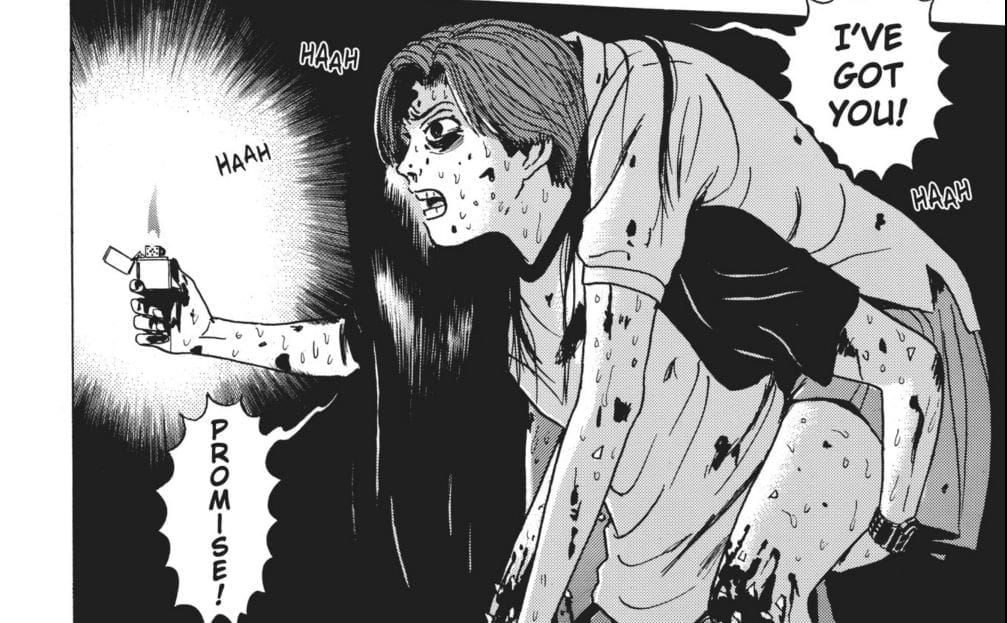
Minetarō Mochizuki: As I mentioned earlier, when I was drawing Dragon Head, I had this instinctive feeling that “an invisible monster was lurking in the world.” In the project proposal I showed my editor, I even drew a “faceless dragon.” Fear has no face or form—it can’t be grasped. That’s what I believed. And perhaps that feeling still lingers in society today.
Anime Herald: Welcome to New York. Any fun stories from your trip or any fun plans for your trip?
Minetarō Mochizuki: My hotel is in the middle of Times Square. It’s a very extravagant location. It feels like such a fancy place. I had a preconception that New Yorkers would be snobs. I have been pleasantly surprised that people have been so nice to me.
Manga Mavericks: Why do you think Dragon Head has continued to be beloved by manga fans decades after its conclusion?
Minetarō Mochizuki: I haven’t been told by too many fans that they love my work, nor have I gotten hate mail or attacked in the night (laughs). So I personally don’t know why, but I feel very blessed to hear that.
Doctor Anime: Teru struggles to remain sane and moral while others spiral. Do you believe fear inevitably strips away humanity, or were you offering a counterpoint through him?
Minetarō Mochizuki: When I was writing Dragon Head, I wanted to highlight that fear is all in our head. So is imagination. It’s all created in the same place. It’s all up to the individual. The choice is yours.
Header Image ©Minetarō Mochizuki, KODANSHA
Anime NYC 2025: Minetarō Mochizuki Discusses Dragon Head – Seth Burn