Table of contents
- What is the “Fight, Flight, Freeze, and the Fawn/Feign Response”?
- Shizuka and the “freeze” response
- How the brain develops a “fawn” response through the lens of Naoki and Marina
- Marina and the demonization of the “fight” response
- Takopi’s realization: toxic positivity and how well-meaning actions lead to more distress
- A poignant finale
With dreamy animations in stark contrast with its dark story, Takopi’s Original Sin is inarguably one of the most successful anime of 2025 among critics and viewers alike.
The manga, written and illustrated by mangaka Taizan5, follows an adorable, octopus-like alien named Takopi, along with three children he meets while on Earth: Shizuka Kuze, Marina Kirarazaka, and Naoki Azuma. As an unrelenting optimist from Planet Happy, Takopi is on a mission to create happiness on Earth with the aid of “Happy Gadgets” from his home planet that possess magic-like qualities. Tragedy quickly ensues when Shizuka ends her life with a gadget, and Takopi utilizes the “Happy Camera” – which allows the characters to relive the photographed moments– to undo Shizuka’s suicide. This spurs the creation of multiple, tragic timelines that take place over the course of six years.
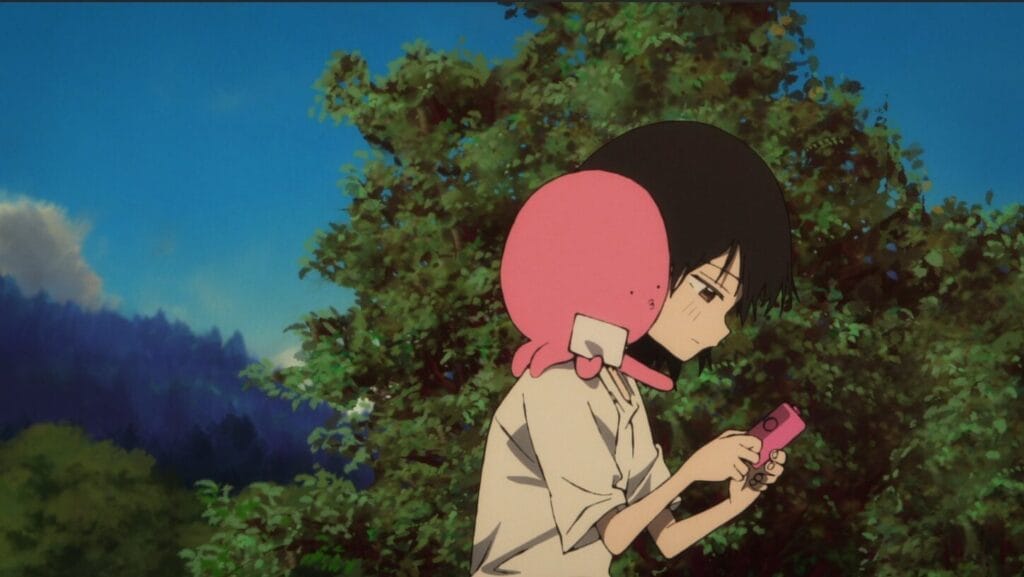
I dove into Takopi’s Original Sin without reading the synopsis; the most I knew about the sci-fi anime came from a few reviews noting the series heavily features posttraumatic stress disorder (PTSD), suicidality, and childhood abuse. I am admittedly a harsher critic of anime that include abuse or PTSD as prominent themes as a health journalist and survivor myself. When fictional pieces include mental health-related storylines without proper care, they feel one dimensional and unworthy of a developed storyline.
However, Takopi’s Original Sin did not disappoint. The series masterfully tackles childhood abuse and PTSD in six short episodes. More specifically, it offers a powerful exploration of the “Fight, Flight, Freeze, and the Fawn/Feign” response framework that guides our real life understanding of trauma.
What is the “Fight, Flight, Freeze, and the Fawn/Feign Response”?
The Rape, Abuse and Incest National Network defines the Fight, Flight, Freeze, and the Fawn/Feign Response as automatic reactions “deeply rooted in our nervous systems and shaped by biology, past experiences, and trauma.” This helps explain the unconscious, psychological ways victims cope with abuse both in the present moment and how they may respond in future situations that are stressful or traumatic.
“When you’re a little one, you don’t get the choice to process what you’re going through,” Adrienne Heinz, PhD, a trauma and addiction research scientist at Stanford University, told SELF in an article. “Your brain adapts to survive.”
Shizuka and the “freeze” response

In the beginning of the series, Takopi the Happian befriends a quiet, 9-year-old Shizuka who is viciously bullied by Marina, her classmate who blames her father’s affair with Shizuka’s mother on Shizuka. Her abuse continues after leaving school; After Shizuka’s father abandons their family, her mother is neglectful. Shizuka’s only source of comfort is her dog, Chappy.
Viewers less familiar with trauma may believe Shizuka is simply depressed. However, the “freeze” response to abuse presents similarly to depression, and is often mistaken for it. As the name implies, the “freeze” response causes the body to emotionally and physically shut down in the face of abuse. The Cleveland Clinic describes this response as feeling like “hitting the pause button altogether.” Like nonfictional victims of abuse who instinctively adopt the freeze survival mode, Shizuka is socially withdrawn, emotionally numb, and almost entirely despondent.
Oblivious to human emotions, Takopi gives Shizuka the Reconciliation Ribbon, a Happy Gadget tied to the pinky fingers of any two people and mends their friendship. Shizuka uses it to end her life after Chappy goes missing, rather than using the ribbon to reconcile with Marina.
The series dramatizes Takopi’s basic lack of emotional intelligence because he is an alien hardwired to only feel happiness. However, this storyline demonstrates a universal misconception that it’s easy to spot when people experience abuse. Through Shizuka’s suicide in the first timeline, Takopi’s excellently conveys that, while freezing in response to abuse appears unassuming, it is serious.
How the brain develops a “fawn” response through the lens of Naoki and Marina
Though originally coined just the “fight or flight” response, mental health experts widely recognize that people experiencing abuse may develop a “fawn/feign” response.
“Rooted in complex trauma, the fawn response emerges when a person internalizes that safety, love, or even survival depends on appeasing others, especially those who hold power over them,” Shreya Mandal, JD, LCSW, NBCCH, a psychotherapist in New York City, explained in an article for Psychology Today. “It is a profound psychological adaptation, often shaped in childhood, in homes where love was conditional, inconsistent, or entangled with emotional or physical threat.”
Naoki, a classmate of Marina and Shizuka, is a prime example of this. He desperately tries to achieve the same academic success as his elder brother, Junya, and to win the approval of his mother. Despite excelling in school, Naoki’s mother chastises and belittles Naoki because of his imperfect test scores, and for simply needing glasses. Pancakes symbolically embody her mental abuse, and Naoki’s response to it: Every time he brings home a test score that’s not perfect, his mother throws away a pile of pancakes she made for him. It is a visual reminder that he is never “good enough,” perpetuating his attempts to please her and put an end to the abusive cycle.

Later in the series, Shizuka retaliates against Marina’s bullying and uses the Happy Camera to murder her with Takopi and Naoki present. This event, unsurprisingly, leaves Naoki in a traumatized, fearful state. In a similar fashion as to how he interacts with his mother, Naoki tries appeasing Shizuka by promising to keep the murder a secret and even considers taking responsibility for it.
He unconsciously begins to dissociate, fidget, and plans to run away with Shizuka to Tokyo – all classic signs of the “flight” response. Though Takopi presents Happy Gadgets, Naoki’s distress intensifies and his response to the ongoing trauma grows more pronounced.
It’s important to note that Marina also reverts to fawning as a means of survival in a way akin to Naoki. The original timeline reveals that Marina is actually the first person Takopi meets on Earth, but he forgets her due to his violation of Planet Happy’s laws. This timeline in Takopi’s Original Sin depicts a very different Marina. When she arrives home from school, she is verbally and physically abused by her mother who places the blame on Marina for her father’s affair (sound familiar?). Despite how much Marina tries placating her mother by keeping her company, preparing her drinks, and maintaining a cheerful composure, it’s all in vain.
Marina and the demonization of the “fight” response
Prior to viewers gleaning deeper insight into the trauma Marina is actively enduring, she is initially introduced as the ruthless antagonist that torments Shizuka mentally, verbally, and physically. Like freeze, the “fight” response is a natural reaction to stressful and traumatic situations.
Though sometimes misinterpreted as just fighting off aggressors in the moment, fight also encompasses how the mind and body continue to respond to situations perceived as threatening or dangerous. Outwardly, this looks like agitation, intense anger, and a tendency to lash out. Marina possesses all these character traits.
Some children divert their anger towards adults or authority they feel “safe” being angry at, but research finds that children experiencing stress or abuse may resort to bullying. As Dr. Jennifer Fraser, Ph.D., writes in a Psychology Today article, “A stress response framework treats bullying as an evolutionary, biological stress response akin to anxiety, dysregulation, and various types of disordered behavior.”
As previously mentioned, Marina cannot appease her mother; she, quite literally, walks on shattered glass. Marina redirects her anger and hurt towards Shizuka, as well as Takopi. In one scene, Takopi unknowingly acknowledges this cycle of abuse by asking Marina, “You’re always rough with me because you’re copying your mama, right-pi?”
In continuance of this cycle, Shizuka redirects her pain towards Takopi and Marina.
This is not to lend credibility to the “abused becomes the abuser” narrative that is weaponized against survivors or to offer an excuse for Marina’s misplaced aggression towards Shizuka. Marina and Shizuka’s violent behavior in certain timelines could be interpreted as stigmatizing, but I believe these narratives demonstrate that trauma responses are acutely complex, especially in children. The fight response is often demonized, but it is rooted in seeking protection just as much as any other reaction.

Takopi’s realization: toxic positivity and how well-meaning actions lead to more distress
Early on in the series, Takopi exclaims “I’m on a quest to spread happiness throughout the universe-pi!” This declaration and the name “Planet Happy” are on the nose but accurately relay the simplified view of abuse and PTSD that still persists today.
In Takopi’s Original Sin, an earnest Takopi offers up Happy Gadgets as solutions to Marina, Shizuka and Naoki that end up compounding the existing harm. This mirrors how, in real life, there is no shortage of well-intentioned people offering unsolicited advice on how to cope with PTSD, such as trying yoga and eating healthy. As I’ve dealt with PTSD in waves, there have been no shortage of people in my life that tell me to “just be happy.”
However, addressing trauma requires more than developing a few tools or coping skills. Recognizing and unlearning unconscious trauma responses requires awareness, time, and patience. As Takopi is accustomed to the spectrum of emotions beyond happiness, he comes to the realization that there is no gadget that can heal Marina, Shizuka, or Naoki.
This leads to one of the most emotional conversations in the anime: Takopi speaks to defeated Shizuka about what he learned during his time spent on Earth. “I’m sorry for always trying to do something for you when I had no idea how you felt, Shizuka-chan,” he says, which causes Shizuka to genuinely cry in a way she seems unable to before this moment.
For people with PTSD, receiving simple acknowledgment of pain surrounding abuse can be a powerful form of support. Creating space for someone to simply cry or talk about their abuse can be lifesaving.
A poignant finale
In a bittersweet conclusion, Takopi sacrifices himself with the Happy Camera to completely rewind time and undo the harm he unintentionally created on Earth. Marina and Shizuka become friends and bond over faint memories of Takopi triggered by a doodle in Shizuka’s notebook. Naoki develops different friendships, never crossing paths with the two girls outside of the classroom. Echoing Takopi’s last sentiments, Marina and Shizuka say together, through tears, that “happiness is born through talking-pi.”
The story is told from the perspective of an extraterrestrial being, but anime’s core themes are painfully human. Without pathologizing the series’ young characters, Takopi’s Original Sin captures the wide breadth of common reactions to abuse and trauma. Each character’s prominent trauma response arises as they navigate abuse and neglect, yet Takopi’s Original Sin never puts them in a neat, little box. The anime completely shatters the myth that there is such a thing as a “perfect” victim or survivor. Like classics that include Monster and Perfect Blue, Takopi’s Original Sin is a masterclass in its portrayal of the complexities of trauma.
Fight, Flight, Freeze, and Fawn: How “Takopi’s Original Sin” Explores Childhood Trauma – Kyli Rodriguez-Cayro